

SVARA Intelligence Journal
Deep Tech & Autonomous Intelligence10–12 minutesPillar Article
What Is Autonomous Intelligence?
How AI Systems Are Moving Beyond Automation
Autonomous intelligence connects perception, context, reasoning, decision and action into one continuous loop — the shift from systems that execute instructions to systems that operate toward objectives.
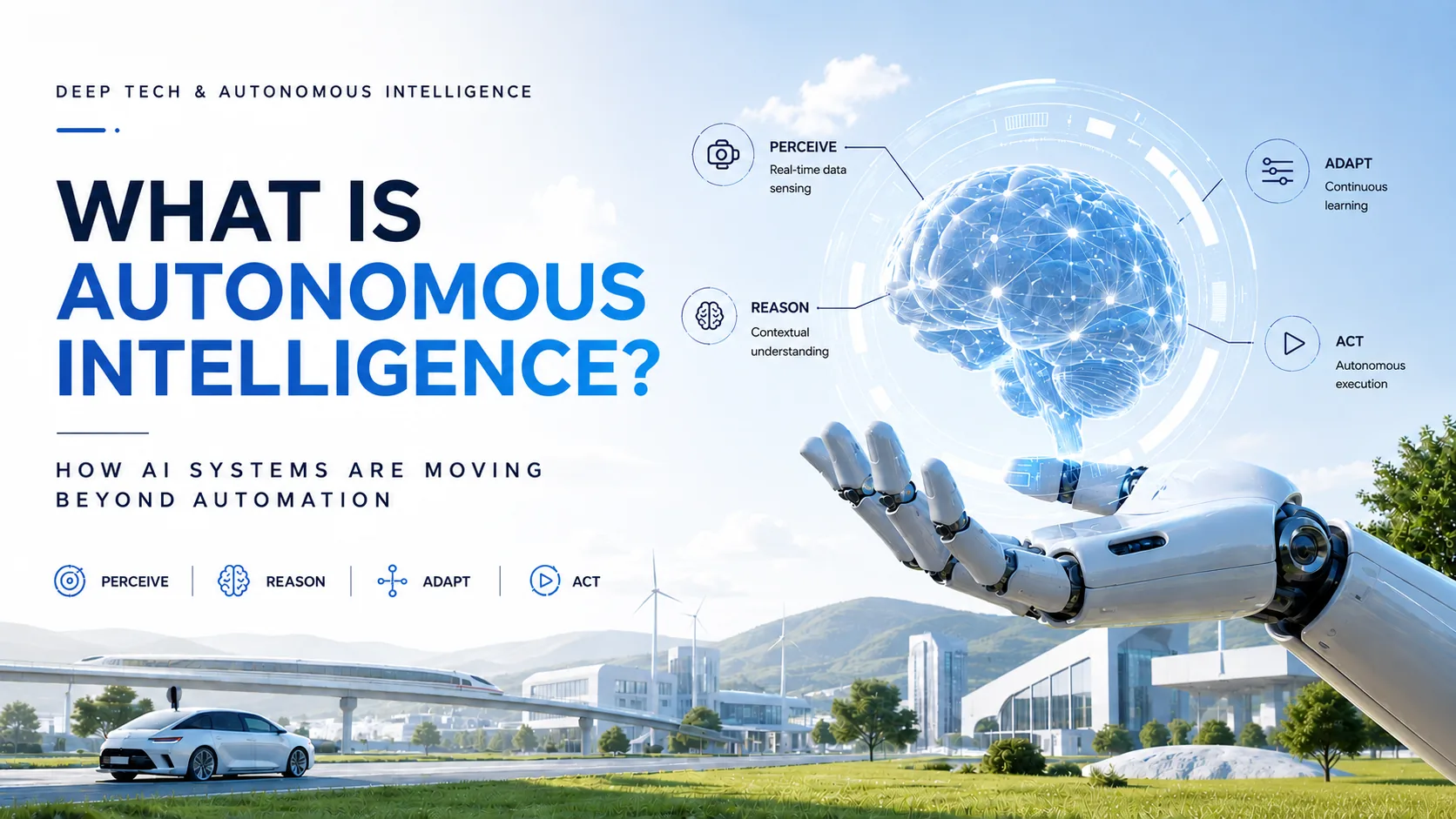
What Is Autonomous Intelligence?
Autonomous intelligence is the ability of an artificial intelligence system to perceive information, interpret context, reason about possible outcomes, make decisions and take actions with a defined level of independence.
Unlike traditional automation, which follows predetermined rules and workflows, autonomous intelligence is designed to respond to changing conditions and make context-aware decisions within defined operational boundaries.
An autonomous system does not simply wait for every instruction.
It can continuously process signals from its environment, evaluate what those signals mean and determine an appropriate next action based on its objectives, available information and permitted constraints.
At its simplest, the progression looks like this:
- Data
- Perception
- Understanding
- Reasoning
- Decision
- Action
- Learning
This shift represents an important evolution in how digital systems operate.
- Traditional software primarily executes instructions.
- Automation executes predefined workflows.
- Artificial intelligence identifies patterns and generates predictions or outputs.
- Autonomous intelligence connects these capabilities into systems that can continuously sense, reason and act.
Automation vs AI vs Autonomous Intelligence
These concepts are often used interchangeably, but they describe different levels of system capability.
| Capability | Traditional Automation | AI-Powered Systems | Autonomous Intelligence |
|---|---|---|---|
| Follows predefined rules | ✓ | ✓ | ✓ |
| Recognises patterns | Limited | ✓ | ✓ |
| Responds to changing conditions | Limited | Moderate | Advanced |
| Reasons across context | ✕ | Sometimes | ✓ |
| Makes decisions | Rule-based | Assisted | Context-aware |
| Takes actions | Predefined | Assisted | Independent within boundaries |
| Adapts to new situations | ✕ | Limited | Designed for adaptation |
| Coordinates multiple systems | Limited | Possible | Core capability |
Traditional Automation
Traditional automation is deterministic.
A system is programmed with a condition:
For example:
If an invoice exceeds a specific amount, send it for approval.
The system performs efficiently when the environment behaves as expected. However, it does not fundamentally understand the context surrounding the event.
AI-Powered Systems
AI introduces the ability to analyse data, identify patterns and generate predictions, recommendations or content.
For example:
Based on previous transactions, this customer has a high probability of churn.
This provides intelligence.
But intelligence alone does not necessarily create autonomy.
A human or another system may still need to decide what happens next.
Autonomous Intelligence
Autonomous intelligence introduces a more connected operational loop.
The system may:
- Perceive what is happening.
- Understand the relevant context.
- Reason about possible responses.
- Select an appropriate action.
- Execute that action through approved systems.
- Observe the result.
- Adapt future behaviour based on new information.
The objective is not to remove humans from every decision.
The objective is to determine which decisions can be handled autonomously, which require human approval and how both can work together inside an intelligent system.
That distinction is where the next generation of intelligent systems begins.
How Does Autonomous Intelligence Work?
Autonomous intelligence is best understood as a continuous intelligence loop, rather than a single AI model.
A model may classify an image, predict an outcome or generate text. An autonomous system connects multiple capabilities so that information can move from observation to action.
1. Perception
The system first receives information from its environment.
Depending on the application, this may come from:
- cameras and computer vision systems;
- IoT sensors;
- enterprise databases;
- documents and knowledge bases;
- software applications and APIs;
- machines and connected infrastructure;
- human interactions;
- real-time operational data.
For example, a computer vision system may detect an object, an anomaly or a change in an environment.
An enterprise intelligence system may instead detect a change in customer behaviour, inventory levels or operational performance.
The source changes.
The underlying principle remains the same:
2. Context and Understanding
Raw data alone is not intelligence.
An autonomous system needs to understand what the information means in relation to its current objective.
Imagine a vision system detecting a vehicle.
A basic system might return:
Vehicle detected.
An intelligent system adds context:
A vehicle has entered a restricted area.
An autonomous system can go further:
A vehicle has entered a restricted area outside authorised operating hours. Its identity cannot be matched to an approved access record.
The difference is context.
This often requires the system to combine multiple information sources rather than interpreting a single signal in isolation.
3. Reasoning
The next stage is determining what should happen.
The system may evaluate:
- the current situation;
- its objectives;
- available actions;
- historical patterns;
- operational constraints;
- risk levels;
- permissions;
- human approval requirements.
For example, if an industrial system identifies an unusual pattern, it may evaluate whether the anomaly is:
- insignificant;
- worth monitoring;
- likely to affect performance;
- serious enough to trigger an alert;
- severe enough to initiate a predefined response.
This is where autonomous intelligence begins moving beyond simple if-this-then-that logic.
The objective is not unlimited machine independence.
A well-designed autonomous system should operate within clear boundaries, permissions and escalation rules.
4. Decision-Making
After evaluating the available context, the system selects an appropriate next step.
That decision may be:
- take no action;
- continue monitoring;
- generate an insight;
- notify a person;
- request approval;
- trigger a workflow;
- interact with another system;
- assign a task to an AI agent;
- execute an approved action.
The level of autonomy can vary significantly.
A low-autonomy system may only make recommendations.
A higher-autonomy system may execute actions independently when the risk is low and the operating boundaries are clear.
5. Action
Intelligence becomes operational when it can connect to the systems capable of producing an outcome.
This is why autonomous intelligence depends on more than AI models.
It may require:
- APIs;
- workflow engines;
- software integrations;
- robotic systems;
- connected devices;
- enterprise applications;
- AI agents;
- orchestration layers.
Consider an AI system that predicts a supply-chain disruption.
A prediction alone provides information.
An autonomous intelligence system could potentially:
- identify the disruption;
- assess affected operations;
- analyse available alternatives;
- generate possible responses;
- route high-risk decisions to a human;
- initiate approved operational workflows.
The intelligence is no longer isolated inside a dashboard.
It becomes part of the operational system.
6. Feedback and Adaptation
Every action creates a new piece of information.
Did the intervention work?
Did the situation change?
Was the prediction accurate?
Does the system need to escalate?
This creates a feedback loop:
- Observe
- Interpret
- Decide
- Act
- Evaluate
- Adapt
Not every autonomous system “learns” continuously in the same technical sense. Some systems adapt through updated rules, feedback mechanisms or model updates rather than real-time model training.
That distinction matters.
Autonomy does not automatically mean unrestricted self-learning.
A production-grade autonomous system should clearly define how it can adapt, what data can influence its behaviour and when human oversight is required.
The Building Blocks of Autonomous Intelligence
A mature autonomous intelligence architecture can combine multiple technologies.
Computer Vision
Computer vision allows systems to interpret visual information from cameras, images and video.
It can support applications such as:
- quality inspection;
- object detection;
- safety monitoring;
- traffic analysis;
- industrial observation;
- retail intelligence;
- infrastructure monitoring.
Vision can become the perception layer of an autonomous system.
Edge AI
Edge AI moves intelligence closer to where data is generated.
Instead of sending every piece of information to a remote cloud environment, models can operate on or near devices and infrastructure.
This can be important when applications require:
- lower latency;
- reduced dependence on continuous connectivity;
- local data processing;
- faster operational responses.
Edge AI can enable autonomous systems to respond closer to real time.
AI Agents
AI agents can act as task-oriented intelligence components.
An agent may be designed to:
- retrieve information;
- analyse documents;
- use approved software tools;
- execute multi-step workflows;
- coordinate tasks;
- communicate results.
Multiple specialised agents can also be orchestrated as part of a larger system.
For SVARA, this is a key transition:
Generative and Cognitive AI
Generative AI can create new content, including text, code, imagery and other outputs.
Cognitive capabilities focus more broadly on interpreting information, reasoning, understanding context and supporting decisions.
Together, these technologies can contribute to systems that not only generate responses, but also participate in more complex intelligence workflows.
Digital Twins and Simulation
A digital twin or simulation environment can provide a space to model systems and evaluate possible outcomes.
For autonomous intelligence, this can support:
- scenario analysis;
- operational forecasting;
- system optimisation;
- risk evaluation;
- testing before deployment.
Instead of acting immediately in every situation, intelligent systems may first evaluate potential outcomes in a simulated or modelled environment.
AI Orchestration
As organisations deploy more models, agents, applications and data sources, orchestration becomes increasingly important.
An orchestration layer can help determine:
- which system should handle a task;
- which data source should be accessed;
- when human approval is required;
- how agents communicate;
- how actions are logged;
- how workflows are coordinated.
This is where technologies such as an AI OS can become strategically important.
What Does Autonomous Intelligence Look Like in the Real World?
Autonomous intelligence does not describe one specific product.
It is an architectural approach that can be applied across physical and digital environments.
Autonomous Industrial Operations
Imagine a manufacturing environment where connected systems continuously monitor:
- machine performance;
- production quality;
- energy consumption;
- environmental conditions;
- maintenance signals.
When a potential issue is detected, the system could:
- identify the anomaly;
- analyse historical and real-time data;
- estimate potential impact;
- recommend or initiate an approved response;
- escalate to a human operator when necessary.
The objective is not simply automation.
It is continuous operational awareness combined with increasingly intelligent action.
Autonomous Drones
Drone systems can combine:
- computer vision;
- edge AI;
- sensor intelligence;
- navigation systems;
- autonomous decision logic.
Potential applications include inspection, monitoring, mapping and data collection.
However, the degree of autonomy must always depend on the application, technical capability, safety requirements and applicable operational or regulatory constraints.
Enterprise AI
Inside an organisation, autonomous intelligence can operate across digital workflows.
For example:
A system identifies a potential customer churn risk.
An AI agent then:
- retrieves relevant account information;
- analyses recent interactions;
- identifies possible contributing factors;
- prepares recommended actions;
- creates tasks or drafts communications;
- routes sensitive or high-impact actions for approval.
This creates a transition from:
- Data
- Dashboard
- Human interpretation
- Manual action
toward:
- Data
- Intelligence
- Context
- Decision
- Coordinated action
The Rise of Human-Autonomous Collaboration
A common misconception is that autonomous intelligence means removing humans from the system.
That is not necessarily the objective.
In many enterprise and industrial environments, the more realistic architecture is human-autonomous collaboration.
The system handles:
- continuous monitoring;
- large-scale data processing;
- pattern recognition;
- repetitive decisions;
- workflow execution.
Humans remain responsible for areas requiring:
- strategic judgement;
- ethical evaluation;
- complex exceptions;
- high-impact decisions;
- accountability.
The important design question becomes:
The answer will be different for every organisation and use case.
Why Autonomous Intelligence Requires More Than a Powerful AI Model
One of the biggest mistakes organisations can make is assuming that deploying a more powerful model automatically creates an intelligent enterprise.
It does not.
A powerful model without the right architecture may still be disconnected from:
- relevant data;
- business context;
- operational workflows;
- approved tools;
- human governance;
- measurable objectives.
Autonomous intelligence requires system design.
A useful framework is:
- Intelligence
- Can the system understand and reason?
- Context
- Does it have access to the information necessary to make a relevant decision?
- Connectivity
- Can it interact with the systems where work actually happens?
- Agency
- Can it take approved actions?
- Governance
- Are permissions, constraints, monitoring and human escalation clearly defined?
Without these layers, an organisation may have an impressive AI demonstration—but not an autonomous intelligence system.
The SVARA Perspective: From Isolated AI to Connected Intelligence
The next stage of AI adoption is not simply adding more AI tools.
It is designing how intelligence moves across an organisation.
At SVARA, the opportunity can be viewed as a connected ecosystem:
- Vision AI
- provides perception.
- Edge AI
- brings intelligence closer to the source of data.
- Drone AI
- extends intelligence into physical environments.
- Generative and Cognitive AI
- support understanding, reasoning and creation.
- AI Agents
- enable task execution and multi-step workflows.
- Digital Twins and Simulation
- help model, test and understand complex systems.
- AI OS
- provides an orchestration layer connecting intelligence, data, applications and actions.
The value emerges when these capabilities stop operating as isolated technologies.
This is the architectural direction behind autonomous intelligence: moving from individual tools toward systems capable of perceiving, understanding, coordinating and acting across increasingly complex environments.
What Are the Benefits of Autonomous Intelligence?
When designed around real operational objectives, autonomous intelligence can help organisations pursue several outcomes.
- Faster Response
- Systems can continuously monitor signals and initiate approved responses faster than workflows dependent entirely on manual observation.
- Greater Operational Visibility
- Connected intelligence can bring together information that would otherwise remain distributed across multiple systems.
- Scalable Decision Support
- AI systems can analyse larger volumes of information and help surface patterns that may be difficult to identify manually.
- Reduced Repetitive Work
- Routine analysis, monitoring and workflow steps can potentially be handled with increasing levels of automation and autonomy.
- More Connected Operations
- When intelligence can interact with enterprise applications, devices and workflows, insights can move closer to action.
What Are the Challenges?
Autonomous intelligence also introduces important technical and organisational challenges.
These include:
- Data quality
- Poor, incomplete or disconnected data can limit system performance.
- Context
- A model may produce an intelligent-looking answer without understanding the complete operational situation.
- Reliability
- Systems need mechanisms for handling uncertainty, failure and unexpected conditions.
- Security
- Greater connectivity and agency can increase the importance of identity, access control and system security.
- Governance
- Organisations need to define permissions, escalation paths and accountability.
- Human oversight
- The appropriate level of human involvement depends on the risk and impact of the decision.
- Integration complexity
- Intelligence only becomes operational when it can interact safely with real systems.
For this reason, the future of autonomous intelligence will depend as much on architecture, integration and governance as it does on model capability.
What Is the Future of Autonomous Intelligence?
The direction is becoming increasingly clear.
AI is moving from systems that primarily respond toward systems designed to participate.
The progression can be viewed as:
- Software executes.
- Automation follows workflows.
- AI generates and predicts.
- Agents perform tasks.
- Autonomous intelligence coordinates perception, reasoning and action.
The next generation of digital systems may increasingly operate as networks of specialised intelligence.
- Some systems will observe.
- Some will reason.
- Some will simulate.
- Some will execute.
- Some will supervise.
Humans will remain part of this architecture—not necessarily as operators of every individual task, but as designers, decision-makers and governors of increasingly intelligent systems.
The challenge for organisations is therefore not simply:
“How do we use AI?”
The more important question is:
That is the shift from AI adoption to intelligence architecture.
Frequently Asked Questions
What is autonomous intelligence?
Autonomous intelligence is the ability of an AI-powered system to perceive information, interpret context, reason about possible outcomes, make decisions and take actions with a defined level of independence and within defined operational boundaries.
What is the difference between automation and autonomous intelligence?
Automation typically follows predefined rules or workflows. Autonomous intelligence can combine perception, context, reasoning and decision-making to respond to changing conditions and select actions within approved constraints.
Is autonomous intelligence the same as AI?
No. AI is a broad category of technologies that can analyse, predict, generate or classify information. Autonomous intelligence refers to a more connected system in which intelligence can participate in a continuous cycle of perception, reasoning, decision-making and action.
What role do AI agents play?
AI agents can function as task-oriented components within an autonomous system. Depending on their permissions and design, they may retrieve information, use tools, execute workflows and coordinate multi-step tasks.
Can autonomous intelligence operate without humans?
Some low-risk or highly defined tasks may operate with limited human intervention. However, the appropriate level of autonomy depends on the application, risk, operational requirements and governance framework. Human oversight remains important for many high-impact decisions.
What technologies are needed to build autonomous intelligence?
The architecture can involve AI models, data systems, computer vision, Edge AI, AI agents, APIs, workflow engines, simulations or digital twins, orchestration systems and governance mechanisms. The exact combination depends on the use case.
Closing Perspective
The future of AI will not be defined by how many models an organisation deploys.
It will be defined by how effectively intelligence can connect with the real world.
Data must become context.
Context must support decisions.
Decisions must connect to action.
And every layer must operate within a system of trust, governance and human accountability.
That is the transition from automation to autonomous intelligence.