
SVARA Intelligence Journal
Simulation12–14 minutesPillar / Cluster Article
What Is a Digital Twin?
How Virtual Models Are Transforming Real-World Systems
A 3D model shows what something is. A digital twin can explain what it is doing and what may happen next — the layer through which intelligent systems come to understand complex physical environments.
What Is a Digital Twin?
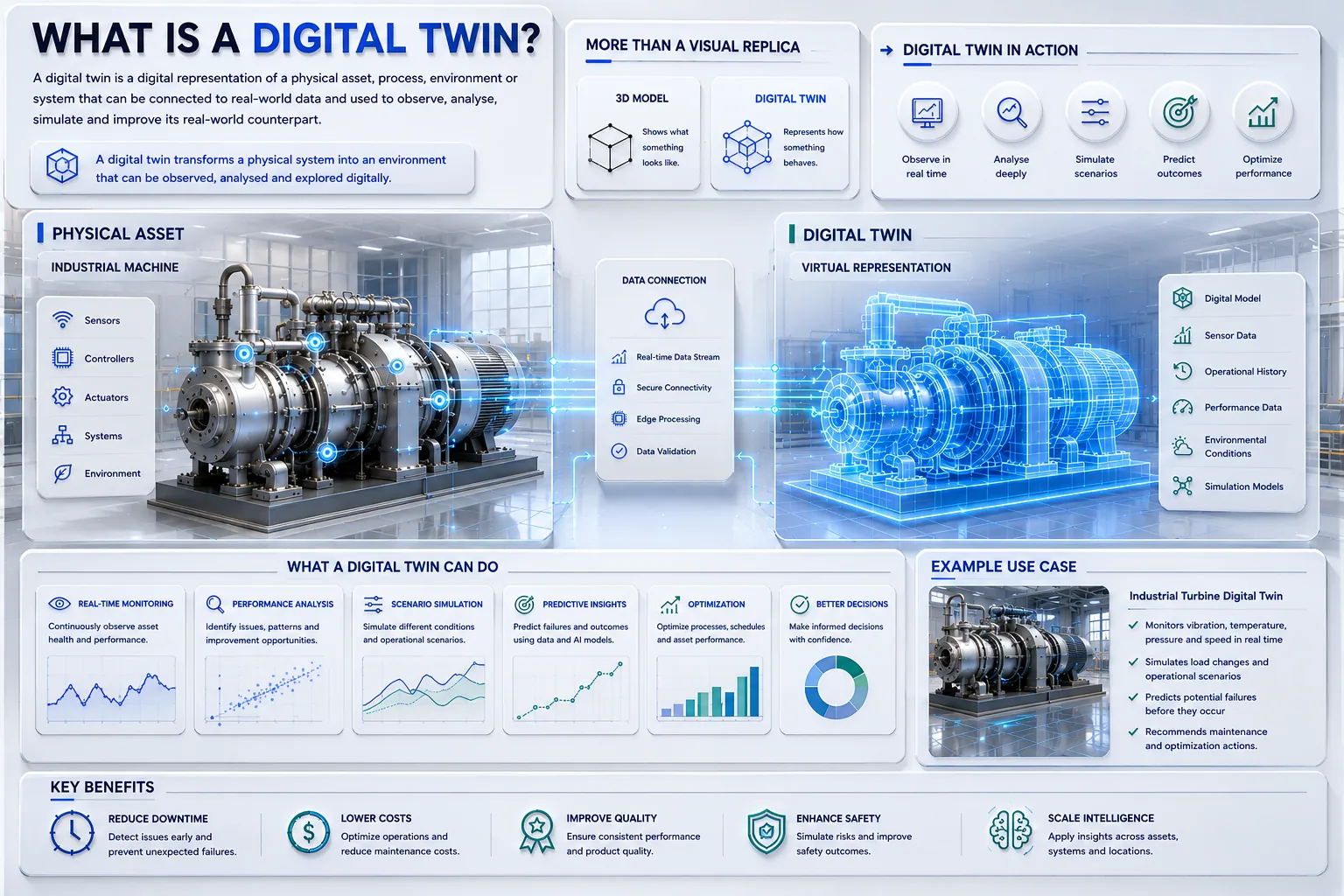
A digital twin is a digital representation of a physical asset, process, environment or system that can be connected to real-world data and used to observe, analyse, simulate and improve its real-world counterpart.
A digital twin is more than a visual replica.
A basic 3D model can show what something looks like.
A digital twin can represent how something behaves.
For example, a digital twin of an industrial machine may combine:
- a digital model of the machine;
- sensor data;
- operational history;
- performance information;
- environmental conditions;
- simulation models.
This creates a connection between the physical system and its digital representation.
The objective is not simply to recreate reality on a screen.
The objective is to create a system that can help people and intelligent technologies better understand reality.
How Does a Digital Twin Work?
The architecture of a digital twin varies depending on the application.
However, many systems involve several connected layers.
1. The Physical System
This is the real-world object, process or environment being represented.
It could be:
- a machine;
- a factory;
- a vehicle;
- a building;
- an energy system;
- a supply chain;
- an infrastructure network;
- an entire operational environment.
2. Data Collection
Information is collected from the physical environment.
This can include:
- sensors;
- cameras;
- IoT devices;
- operational systems;
- enterprise databases;
- historical records.
The data provides the digital system with information about what is happening in the physical environment.
3. The Digital Representation
The information is connected to a digital model.
Depending on the use case, this may include:
- 3D representations;
- mathematical models;
- process models;
- simulation environments;
- system relationships.
This is the layer that creates a structured representation of the real-world system.
4. Analysis and Simulation
Once the system is represented digitally, organisations can analyse information and explore potential scenarios.
For example:
- What happens if production speed increases?
- What happens if a component fails?
- What happens if demand changes?
- What happens if an operational process is redesigned?
The digital environment allows organisations to explore possibilities without immediately applying those changes to the real-world system.
5. Feedback and Action
Insights from the digital twin can inform decisions in the physical world.
The complete loop can become:
- Physical System
- Data Collection
- Digital Twin
- Analysis + Simulation
- Insight + Decision
- Action in the Real World
- New Data
- Updated Digital Twin
This continuous relationship is what makes the concept particularly powerful.
Digital Twin vs 3D Model
A 3D model and a digital twin are not the same thing.
A 3D model primarily represents appearance and structure.
A digital twin can incorporate data, behaviour and relationships.
| Capability | 3D Model | Digital Twin |
|---|---|---|
| Visual representation | ✓ | ✓ |
| Represents physical structure | ✓ | ✓ |
| Connected to operational data | Limited | ✓ |
| Represents behaviour | Limited | ✓ |
| Supports analysis | Limited | ✓ |
| Supports simulation | Sometimes | ✓ |
| Can reflect changing conditions | Limited | ✓ |
| Connected to real-world systems | Usually not | Often |
A useful way to think about it is:
The sophistication of a digital twin depends on its architecture.
Not every digital twin needs real-time data or a photorealistic visual representation.
The value comes from how effectively the digital representation supports understanding and decision-making.
Digital Twin vs Simulation
Digital twins and simulations are also closely related but distinct concepts.
A simulation models how a system might behave under specific conditions.
A digital twin can provide a broader and more persistent representation connected to an actual system.
For example:
A simulation may ask: What happens if this machine operates at 20% higher capacity?
A digital twin may combine information about the actual machine’s:
- current condition;
- operational history;
- maintenance records;
- sensor data.
The simulation can then potentially use the digital twin as a more informed representation of the real-world system.
| Capability | Simulation | Digital Twin |
|---|---|---|
| Models scenarios | ✓ | ✓ |
| Represents system behaviour | ✓ | ✓ |
| Connected to physical system | Not necessarily | Often |
| Uses live or operational data | Optional | Often |
| Persistent representation | Not necessarily | ✓ |
| Supports what-if analysis | ✓ | ✓ |
The technologies are complementary.
What Data Does a Digital Twin Use?
A digital twin can combine multiple forms of information.
- Real-Time Operational Data
- Depending on the system: temperature, speed, location, energy consumption, equipment status and environmental conditions.
- Historical Data
- Previous information can help identify trends, patterns, recurring issues and performance changes.
- Enterprise Data
- Operational context may come from ERP systems, maintenance platforms, supply chain systems and asset management systems.
- Visual and Spatial Data
- This can include computer vision, 3D scans, geospatial data, CAD models and mapping systems.
The combination of these data layers can create a more complete representation of the system.
AI and Digital Twins
Artificial intelligence can significantly expand what a digital twin can do.
Without AI, a digital twin can provide visibility and simulation.
With AI, it can potentially support:
- pattern recognition;
- anomaly detection;
- forecasting;
- optimisation;
- predictive maintenance;
- automated analysis.
For example:
A machine’s digital twin may continuously receive operational data.
An AI system could identify a pattern that suggests abnormal behaviour.
The system could then:
- detect the anomaly;
- compare it with historical patterns;
- estimate potential consequences;
- simulate possible scenarios;
- recommend an action.
This creates a progression from:
- Observation
- Analysis
- Prediction
- Decision
When AI agents are introduced, the system can potentially progress further toward:
- Observation
- Analysis
- Prediction
- Decision
- Action
This is where digital twins can become part of a broader autonomous intelligence architecture.
Digital Twins and Predictive Maintenance
One of the most recognised applications of digital twin technology is predictive maintenance.
Traditional maintenance strategies often follow one of two approaches.
- Reactive Maintenance
- Repair the system after something fails.
- Scheduled Maintenance
- Perform maintenance at predetermined intervals.
Predictive maintenance introduces another possibility.
Use operational information to identify signs that a problem may be developing.
A digital twin can help combine:
- sensor information;
- historical performance;
- maintenance records;
- operational conditions.
AI can then help identify patterns associated with potential issues.
The objective is not to guarantee that every failure can be predicted.
It is to improve the ability to detect and respond to meaningful signals.
Potential outcomes include:
- earlier identification of anomalies;
- better maintenance prioritisation;
- reduced unexpected downtime;
- improved operational visibility.
Digital Twins in Manufacturing
Manufacturing environments involve interconnected systems.
A production line may include:
- machines;
- robotics;
- sensors;
- materials;
- people;
- software systems.
A digital twin can create a structured representation of these relationships.
Possible applications include:
- monitoring equipment;
- analysing production performance;
- testing process changes;
- identifying bottlenecks;
- simulating capacity changes;
- supporting maintenance decisions.
Instead of changing a physical production environment immediately, organisations may first explore scenarios within the digital environment.
Digital Twins in Infrastructure
Infrastructure systems can be highly complex and geographically distributed.
Digital twin technologies can potentially support representations of:
- buildings;
- transport systems;
- energy networks;
- utilities;
- industrial facilities;
- urban environments.
A digital representation can bring multiple data sources into a more unified operational view.
For example:
- Physical Infrastructure
- Sensors + IoT + Visual Data
- Digital Representation
- AI Analysis
- Simulation
- Operational Decisions
This can help organisations understand relationships that may otherwise be distributed across disconnected systems.
Digital Twins and Smart Cities
A city can be viewed as a highly complex system.
It includes:
- transport;
- infrastructure;
- energy;
- buildings;
- environmental systems;
- public services.
A digital twin can potentially provide a framework for modelling parts of these interconnected environments.
Potential applications include:
- traffic analysis;
- infrastructure monitoring;
- energy optimisation;
- urban planning;
- environmental analysis.
However, city-scale systems introduce significant challenges around:
- governance;
- data access;
- interoperability;
- privacy;
- security.
Technology alone does not create an intelligent city.
The surrounding data, infrastructure and governance architecture are equally important.
Digital Twins in Logistics and Supply Chains
Supply chains involve constantly changing variables.
These may include:
- inventory;
- transportation;
- demand;
- supplier conditions;
- production capacity.
A digital representation of a supply chain can help organisations analyse the relationships between these components.
Simulation can then explore scenarios such as:
- What happens if a supplier becomes unavailable?
- What happens if demand increases?
- What happens if a transport route is disrupted?
The value comes from moving beyond isolated dashboards toward a more connected model of the system.
The Role of Edge AI in Digital Twins
Some physical systems generate significant volumes of data.
Sending every piece of information to central infrastructure may not always be necessary.
Edge AI can process selected information closer to the source.
For example:
- Camera or Sensor
- Edge AI
- Event Detection
- Relevant Data Sent to Digital Twin
This can create a more efficient intelligence pipeline.
Instead of continuously transmitting everything, systems can identify meaningful events closer to where they occur.
The digital twin then receives structured and relevant information for broader analysis.
Digital Twins, AI Agents and Autonomous Systems
The potential becomes even more significant when digital twins are connected with AI agents.
Imagine an industrial environment.
- A digital twin identifies an unusual pattern.
- An AI system analyses possible causes.
- The digital twin simulates different responses.
- An AI agent retrieves relevant maintenance information.
- The agent prepares a recommended action.
- A human approves the response, or the system executes a predefined low-risk action.
The architecture becomes:
Physical World
The real asset, process or environment
Perception + Data
Sensors · Cameras · Operational systems
Digital Twin
Structured representation of the system
Simulation
Scenario and what-if analysis
AI Reasoning
Pattern recognition · Prediction · Optimisation
AI Agent
Retrieval · Coordination · Workflow execution
Human Approval / Autonomous Action
Governed response
This creates a connected intelligence loop between the physical and digital world.
Challenges in Building Digital Twins
Digital twins are powerful in concept, but building useful systems can be complex.
- Data Quality
- A digital twin is only as useful as the information supporting it. Incomplete, outdated or inconsistent data can limit its value.
- Interoperability
- Information may exist across many disconnected systems. Connecting those systems can be a major challenge.
- Model Accuracy
- A digital representation does not perfectly replicate reality. The system must be designed with an understanding of what it represents and what it does not.
- Infrastructure Complexity
- Real-world systems can involve thousands or millions of data points. The infrastructure must be able to process, store and manage relevant information.
- Governance
- Digital twins may represent important physical or operational systems. Questions around security, access and accountability are critical.
How Should Organisations Start with Digital Twins?
The best starting point is not:
“Let’s build a digital twin of everything.”
Instead, start with a meaningful operational problem.
For example:
- unexpected equipment downtime;
- limited visibility;
- inefficient processes;
- complex planning decisions;
- infrastructure monitoring.
Then ask:
- What system needs to be represented?
- What decisions need to improve?
- What data is available?
- What additional data is required?
- Does the system need real-time information?
- Where can simulation add value?
- What actions could eventually be automated?
The SVARA Perspective: An Intelligence Layer Between Reality and Decision
Digital twins represent a bridge between the physical and digital worlds.
For SVARA, their potential becomes even greater when connected with other forms of intelligence.
- Vision AI
- can observe.
- Edge AI
- can process information locally.
- Digital Twins
- can represent and simulate.
- Generative & Cognitive AI
- can interpret.
- AI Agents
- can coordinate.
- AI OS
- can orchestrate.
Together, these technologies can form a larger intelligence architecture.
- Physical Reality
- Data + Perception
- Digital Representation
- Simulation + Intelligence
- Reasoning + Agency
- Decision + Action
The digital twin is therefore not just a model.
It can become part of the infrastructure through which intelligent systems understand complex real-world environments.
Frequently Asked Questions
What is a digital twin in simple terms?
A digital twin is a digital representation of a physical object, system or process that can use real-world and operational data to help monitor, analyse or simulate its behaviour.
Is a digital twin just a 3D model?
No. A 3D model primarily represents visual appearance or structure. A digital twin can additionally represent data, relationships and behaviour.
What is the difference between a digital twin and simulation?
Simulation is generally used to explore how a system may behave under different conditions. A digital twin can provide a broader representation of an actual system, potentially incorporating operational data that can inform simulations.
How does AI improve a digital twin?
AI can help analyse complex information, identify patterns, detect anomalies, make predictions and support optimisation.
What industries use digital twins?
Digital twin technology can be applied across manufacturing, infrastructure, logistics, energy, buildings, transportation and other complex physical or operational environments.
Do digital twins require real-time data?
Not always. The required update frequency depends on the use case. Some digital twins may use near-real-time operational data, while others may update periodically.
Can AI agents work with digital twins?
Yes. AI agents can potentially retrieve information from digital twins, analyse scenarios, coordinate workflows and support actions within defined permissions and governance boundaries.
Closing Perspective
The world is full of systems that are difficult to understand because they are complex, distributed, constantly changing and interconnected.
Digital twins offer a way to create a structured digital representation of those systems.
They can connect data with models.
Models with simulations.
Simulations with AI.
And AI with decisions.
The opportunity is not simply to create a digital copy of reality.
It is to create a more intelligent relationship with reality itself.
The physical world generates data. Digital twins provide context. Simulation explores possibilities. AI finds patterns. Agents coordinate action.
Together, these capabilities can move organisations toward a future of more connected, adaptive and autonomous intelligence.